
Wet and Dry, Fire and Ice:
Visiting Seven of America’s Natural Wonders
VOICE TWO: Now we travel to the north central part of the
country. We are in the state of South Dakota. The land is big
and mostly flat with many fields of corn, wheat and soybeans.
But as we travel west, the cropland gives way to wild grasses.
A strong dry wind blows continuously from the west.
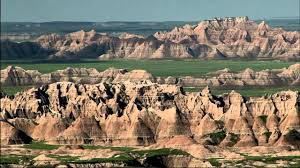
Suddenly, the land becomes torn and rocky, dry and dusty --
no longer green and gold. It is now a light red-brown color. All around are broken disordered forms.
There are hills and valleys of all sizes and strange shapes.
VOICE ONE: These are the Badlands. Hundreds of thousands of years ago the area was
grassland. But, then, forces of nature destroyed the grass. Water and ice cut into the surface of the
earth. They beat at the rocks, wearing them away. The result is one of the world’s strangest sights.
All together, the Badlands cover more than fifteen thousand square kilometers. About ten percent
is national parkland. The area is a study in extremes. Temperatures in the summer have been as
high as forty-six degrees Celsius. In the winter they have dropped to as low as forty-one degrees
below zero. Life in the Badlands is difficult. But animals do survive. The most well known is the
prairie dog. This small mammal lives in a series of underground passages.


Wet and Dry, Fire and Ice:
Visiting Seven of America’s Natural
Wonders
VOICE TWO: Now we travel to the north central
part of the country. We are in the state of South
Dakota. The land is big and mostly flat with
many fields of corn, wheat and soybeans. But
as we travel west, the cropland gives way to
wild grasses. A strong dry wind blows
continuously from the west.
Suddenly, the land becomes torn and rocky, dry
and dusty -- no longer green and gold. It is now
a light red-brown color. All around are broken
disordered forms. There are hills and valleys of
all sizes and strange shapes.
VOICE ONE: These are the Badlands.
Hundreds of thousands of years ago the area
was grassland. But, then, forces of nature
destroyed the grass. Water and ice cut into the
surface of the earth. They beat at the rocks,
wearing them away. The result is one of the
world’s strangest sights.
All together, the Badlands cover more than
fifteen thousand square kilometers. About ten
percent is national parkland. The area is a study
in extremes. Temperatures in the summer have
been as high as forty-six degrees Celsius. In
the winter they have dropped to as low as forty-
one degrees below zero. Life in the Badlands is
difficult. But animals do survive. The most well
known is the prairie dog. This small mammal
lives in a series of underground passages.
